January 5, 2026
Cultivating Local Technological Independence
A manifesto for fellow grass-roots organizers
A vague awareness of the tech industry's destructive impact on human culture is a good start, but it's not enough. A clear picture of what is broken along with viable alternatives is required before meaningful change can take place. The goal of this writing is to lay this out in plain and actionable terms.
Prior to the Internet and Google, humans had about 200,000 years in which local communication served as the backbone of human culture. While the printing press, telephone and Internet each expanded our reach, Google is the first to restrict it, globally, and to an alarming extent.
Today, a whopping 94% of Google search results are non-local, even when 'near me' is included in the search and the omitted local results are verified to exist within the Google network. Imagine our ancestors asking where the nearest water could be found only to be told it's fifteen miles away when in fact it's one mile away. This is precisely what Google has done and we only have to follow the money -as search result rankings- to see how far Google has gone from being the gateway to the Internet, to gatekeeper.
Leveraging Benchmark Data To Measure Google's Divisive Impact
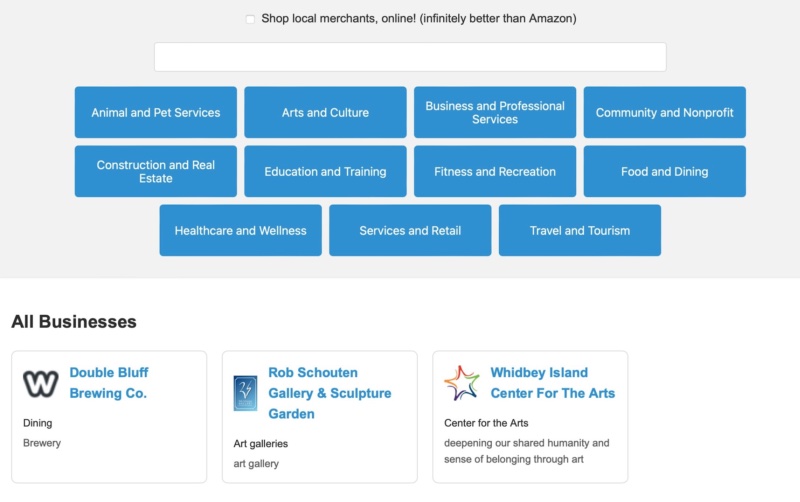
Fortunately, no matter how complex and confidential Google's algorithm and AI may be, there is a finite set of correct responses to queries such as 'plumbers near me,' 'counselors near me,' and so on. With enough due diligence, these locally available resources can be found and the extent to which Google is including or excluding them can be measured. Here, the South Whidbey Online directory was born, sourcing from dozens[1] of resources including active business licenses (cross referenced with Google and Facebook searches) the most recent phone book, and community directories by nonprofits, the chambers of commerce, farmers, and artists.
So What, Exactly, Is Broken?
"Show me the incentive and I'll show you the outcome." - Charles Munger
The incentive in big-tech is to maximize screen-time for maximum revenue[2] and the outcome is cultural destruction. This destruction wears many labels including the 'enshittification' of the Internet, the AI slop epidemic, the accelerating polarization of American politics, and surveillance pricing, to name a few. We describe an additional problematic outcome yet one which is within our control at the local level: the gatekeeping of local communications.
While secretive search algorithms and chatty AIs are ideally suited for big tech's incentive/outcome combination, there is another formula entirely when minimum screen-time and maximum-productivity are the incentives. These are:
- Authentic search - search which is free of cryptic and biased algorithms. (The importance of which, ironically, is best described by Google's founders in their 1998 landmark paper "The Anatomy of a Large-Scale Hypertextual Web Search Engine," Appendix A "Advertising and Mixed Motives.")
- Categories: Categories represent data as it empirically exists, as distinct from the temporal views of algorithmically generated content. This phenomenon (the importance of taxonomical data for information retrieval) was also understood by Google's pioneering founders, as outlined here. In a broader sense, the disappearance of categories across commercial Internet platforms in general may be best described by Vitalik Buterin's essay on the revenue-evil curve. Certainly there is less money to be made when broad, categorical searches can be completed in an instant. In 2026, structured data is increasingly vital for information retrieval, due in part to groundbreaking new standards like MCP which makes structured data accessible via natural language. More on that in the next section.
- AI. As with authentic search, AI is not only a productive tool when the incentive is right, but it may just be the key to our way out of this mess!
To summarize, our reliance on technology built with the wrong incentives will continue to produce the wrong outcomes. Specifically, our reliance on algorithmically generated content will continue to serve the owners of the algorithms at our expense. Yet with great challenges come great opportunities. If there's one silver lining, it's that the big-tech platforms have become so bloated with ads and burdensome to use, it has never been easier to build better, faster, and safer alternatives.
What Can We Do?
- We have the right and the means to use tools like Internet search and AI without our every inquiry being part of a 3rd party monetization and tracking scheme. This can be accomplished by deploying services like Google search and ChatGPT via their back-end systems, called APIs, which already account for the majority of search and AI usage. The key difference being the incentive of our deployment will be to protect end-user privacy, and the expected outcome will be more authentic responses and far greater privacy controls for individual users. 501(c)(3) ownership and full transparency, including monthly audits assigned by lottery, will be required. For now, development is underway as South Whidbey Online, A Social Purpose Corporation.
But doesn’t this mean we’re just accessing the same biased data with just a bit more anonymity? Not quite. Unlike Google’s origin story, where they rose to dominance purely as a result of their proprietary algorithm being that much better than the competition, today’s landscape is characterized by an open-source AI ecosystem in which whomever controls the deployment effectively controls the entire experience. If you’re not already excited about this, it’s time to get excited, because once such open standard is for how AIs can access structured data, called the Model Context Protocol, which is already broadly adopted and most recently gained formal support by the nonprofit AAIF (think Linus Torvalds, inventor of Linux which powers all large servers world-wide, is now all-in with the creation of AAIF for this new ecosystem.) One example of this in action would be a “prioritize South Whidbey” checkbox in the chat interface. The South Whidbey MCP server is already live and includes self-service for end-user editing capabilities. This means if you change your business hours at 9:01am then at 9:01am those changes will show up via natural language chat or conventional search. This is a new-world, and participation is required! - Take ownership of our community's collective identity, starting with our publicly-facing individuals and organizations, as the definitive source for who we are. Facebook and Google have demonstrated they can't do as good of a job as we can (they have too many advertisers to please) so it's up to us to make sure our community members can connect with our available resources, easily and comprehensively. South Whidbey Online, A Social Purpose Corporation, has taken the first step by copyrighting our community's collective identity to make sure it can always be used freely and for good (creative commons ShareAlike).
- Organize and mobilize to make our online community more representative of who we are in-person. We prefer to buy local. We prefer being off-line to being online. If we must be online, how can we make the experience as healthy and productive as possible? There are so many ways we can do better, it's approaching the paradox of choice, where the over-abundance of options results in decision paralysis. For this reason, this initiative takes an infrastructure-first approach, so we can provide essential services while the surveys come back on what our community wants to prioritize. In many respects, this mission for local technological independence mirrors a larger movement called digital sovereignty, in which entire countries and continents are striving to break free from the shortlist of U.S. based big-tech options. For instance, products like Office 365 and iCloud have open-source alternatives like NextCloud, which we could host on our own physical cloud hardware while also winning on price, quality, ease-of-use and most importantly, integrity- yet only at scale and only as a movement because there is no room (nor logic) for paying Google or Facebook to help us use them less.
In conclusion, our humanity depends on our ability to control how we connect with one another, and how much, if any, personal information we choose to share in the process. The current situation with big-tech knowing us better than we know ourselves is unacceptable, and the idea of this happening with our children is unthinkable. For all the uncertainty and risks surrounding the emergent technology of today, we don't need to compound these risks by utilizing implementations with known mis-aligned incentives. What's more, the service quality of the status quo has grown to be so poor, not only can we build services where the end-users actually have rights (as distinct from being a product to be marketed to) but in doing so, the simplicity of this non-bait-and-switch, non-upselling and non-crossselling ecosystem makes it easier to create services which are outright pleasant to use.
If one community can do it, maybe we all can. Let's be the change we want to see. Donate today to help make our online community, our own.
Fitch Daniel Pitney
Venmo @Fitch-Pitney
Mobile 206.383.6903
[1] (1 of 9) The Washington Secretary of State list of active organizations of all types in the four-zip code region of South Whidbey, (2) the Langley Chamber of Commerce, (3) the Clinton Chamber of Commerce, (4) Whidbey and Camano Islands, (5) South Whidbey Island Yellow Pages, (6) Whidbey Community Foundation, (7) Whidbey and Camano Islands Roadside Farm Stands, Farm Stores and Farmers Markets, (8) Whidbey Island Grown Cooperative, (9) Whidbey Island Arts Council.
[2] A deep dive on the $259B in annual revenue generated from Internet Advertising (which can also be thought of as $55 per month per Internet user in the United States) is available here: https://www.iab.com/wp-content/uploads/2025/04/IAB_PwC-Internet-Ad-Revenue-Report-Full-Year-2024.pdf